
Spotted Leaf-nosed Snake
Phyllorhynchus decurtatus
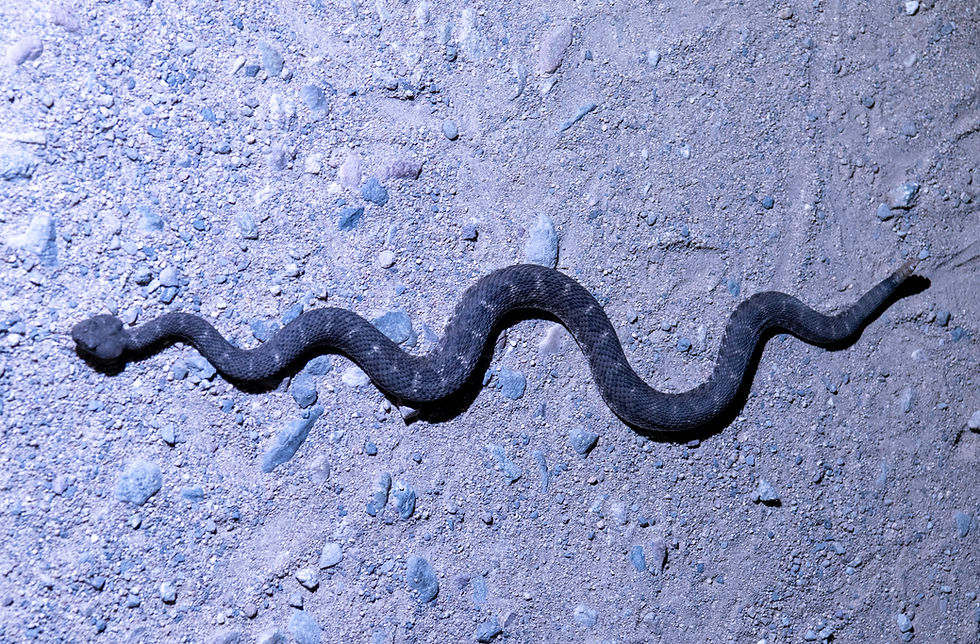
The Spotted Leaf-nosed Snake is a small desert-dwelling snake, typically reaching lengths of 30 to 51 cm (12–20 inches). Its dorsal coloration ranges from pale tones such as tan, cream, pinkish-tan, or pale gray, accented by 24 to 74 small, irregular brown blotches that extend along the body and tail. The sides are often patterned with smaller spots, and a subtle dark line can sometimes be seen running from the eye down to the upper lip. The snake’s underside is unmarked and pale, typically white or light gray. One of its most distinctive features is the large, blunt, triangular rostral scale at the snout, which gives it a “leaf-nosed” appearance and is used for digging. The pupils are vertically elliptical, and the smooth, glossy scales contribute to its sleek appearance. It closely resembles the Saddled Leaf-nosed Snake (Phyllorhynchus browni), but differs by having more than 17 dorsal blotches.
The Spotted Leaf-nosed Snake is found across portions of the southwestern United States and northwestern Mexico. Its U.S. range spans southern and central Arizona, southern Nevada, and southeastern California—including desert sinks below sea level up to elevations around 1,220 meters (4,000 feet). The snake's range continues south into Baja California and parts of Sonora, Mexico. In Arizona, it is particularly associated with the state's western and southwestern desert regions. This species thrives in arid desert environments, particularly within the Sonoran and Mojave Desertscrub ecosystems. It is commonly found on sandy or gravelly soils, open desert plains, and rocky bajadas, and is often associated with vegetation communities dominated by creosotebush, saguaro cactus, and mesquite. It may occasionally be found at the edge of Semidesert Grassland habitats and in large desert drainages or washes within mountain foothills. A secretive and nocturnal species, the Spotted Leaf-nosed Snake spends much of its life hidden beneath the surface, using its reinforced rostral scale to burrow through loose desert soils. It becomes more active during the hot, dry summer months—particularly in June—when it is most likely to be observed moving across desert roads or terrain at night. In colder months, it retreats into hibernation. Despite its reclusive lifestyle, it is among the more commonly encountered desert snakes during summer nighttime hours. This snake exhibits a highly specialized diet, feeding primarily on the eggs of lizards, and possibly snake eggs as well. On occasion, it may also consume small lizards such as banded geckos. Its strong, shovel-like snout is believed to be an adaptation for excavating underground reptile nests in search of these food sources. Reproduction occurs in the late spring to early summer, with females laying clutches ranging from 2 to 6 eggs. Egg-laying likely occurs in June or July, and hatchlings begin emerging later in the summer, typically by July. The small clutch size is consistent with the snake's relatively small body size and secretive nature. The Spotted Leaf-nosed Snake is often confused with the Saddled Leaf-nosed Snake due to similar morphology, but careful observation of dorsal blotch count helps distinguish between the two. It appears to coexist with its relative in some overlapping regions but may favor rockier habitats when in close proximity. Its presence correlates closely with regions where creosotebush is dominant, suggesting a habitat preference that may influence its range and behavior.


References:
Stebbins, R. C., & McGinnis, S. M. (2018). Peterson Field Guide to Western Reptiles and Amphibians (4th ed.). Houghton Mifflin Harcourt.
Brennan, T. C. (n.d.-e). Spotted Leaf-nosed Snake. The Reptiles and Amphibians of Arizona. https://reptilesofaz.org/snakes-subpages/h-p-decurtatus/
Brennan, T. C., & Holycross, A. T. (2006). A field guide to Amphibians and reptiles in Arizona (2nd ed.). Arizona Game and Fish Dept.