top of page

Eastern Collared Lizard

Crotaphytus collaris

This species spans a wide range across the central and southwestern United States, from southeastern Utah and Colorado eastward to Missouri, and south through central Texas, New Mexico, and Arizona into northern Mexico, reaching as far south as Zacatecas and San Luis Potosí. In Arizona, they are most common between 1,400 and 8,500 feet in elevation. The Eastern Collared Lizard's range overlaps with that of the Great Basin Collared Lizard in certain areas, where hybridization may occur.

Eastern Collared Lizards favor rugged, rocky landscapes where they can bask and hunt. They inhabit desert shrublands, sagebrush flats, grasslands, piñon-juniper woodlands, and rocky forest edges. Critical habitat features include abundant large rocks or boulders used for basking, lookout posts, and territory defense. They are typically found in areas with sparse vegetation that allow for open ground movement and sufficient warmth.

Primarily active during the day, these lizards are often observed soaking up the morning sun on prominent rocks. In cooler months, they retreat into hibernation. Known for their agility, they are capable of impressive bipedal sprints, raising their forelimbs off the ground and using their stiff, non-regenerative tails for balance. Eastern Collared Lizards are highly territorial, particularly aggressive toward rival males, and they can inflict painful bites with their strong jaws if handled.

Carnivorous by nature, Eastern Collared Lizards prey on a variety of insects such as grasshoppers, beetles, moths, and wasps, as well as spiders, smaller lizards, and occasionally small snakes. They are opportunistic feeders and will also consume some plant material, including berries, flowers, and leaves when available.

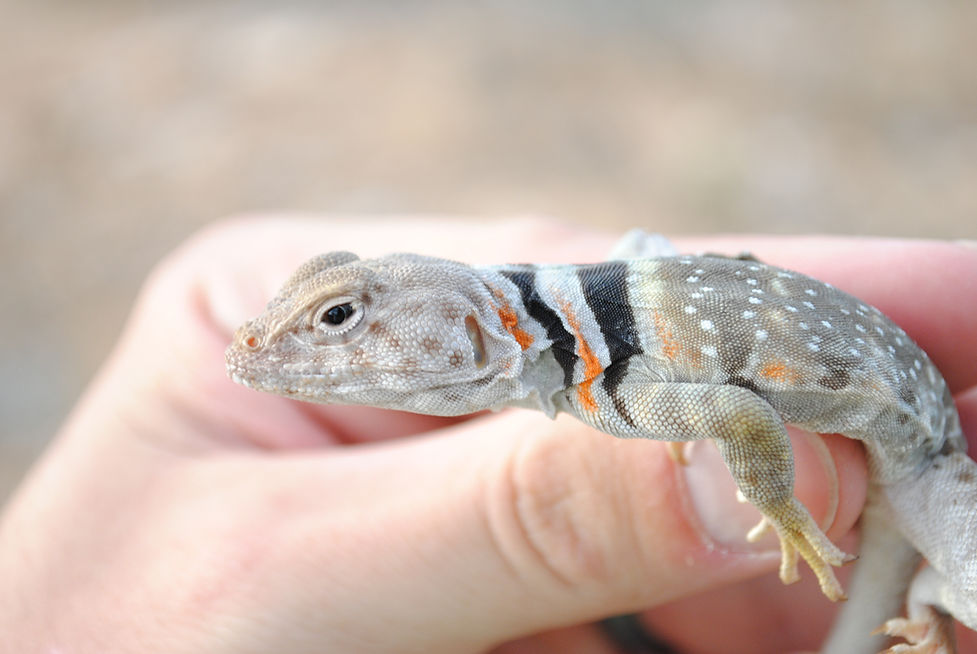
Breeding occurs in the spring and early summer, with females laying clutches of up to 14 eggs, though clutch size can sometimes reach as many as 24. Gravid females often display vivid orange-red markings along their neck and sides, which fade shortly after laying their eggs. Hatchlings typically emerge later in the summer months.

The Eastern Collared Lizard is sometimes confused with its relative, the Great Basin Collared Lizard, but can be distinguished by its more colorful appearance, incomplete anterior neck band, and dark mouth lining. Despite its ferocious appearance and strong bite, the species is highly photogenic and often allows close approach by slow-moving observers, making it a favorite subject for reptile photographers.

The Eastern Collared Lizard is a medium-sized, stout-bodied reptile, reaching lengths up to about 118 mm (roughly 4.6 inches) from snout to vent. It is easily recognized by its broad, blunt head and two distinct black bands around its neck, with the front band notably not extending fully across the throat. Its granular scales cover a body colored in shades that vary from blue-green to gray-brown, often accented with diffuse yellow crossbands and many small, pale spots. Yellow tones frequently appear on the head and front limbs, while the underbelly remains pale and unmarked. Males tend to show brighter coloration with more vivid green hues, while females are typically drabber, sometimes exhibiting orange to red bars along their sides during the breeding season. The tail is long, round in cross-section, and patterned with light backgrounds and dark spots, reversing the body's typical coloration.
This species spans a wide range across the central and southwestern United States, from southeastern Utah and Colorado eastward to Missouri, and south through central Texas, New Mexico, and Arizona into northern Mexico, reaching as far south as Zacatecas and San Luis Potosí. In Arizona, they are most common between 1,400 and 8,500 feet in elevation. The Eastern Collared Lizard's range overlaps with that of the Great Basin Collared Lizard in certain areas, where hybridization may occur. Eastern Collared Lizards favor rugged, rocky landscapes where they can bask and hunt. They inhabit desert shrublands, sagebrush flats, grasslands, piñon-juniper woodlands, and rocky forest edges. Critical habitat features include abundant large rocks or boulders used for basking, lookout posts, and territory defense. They are typically found in areas with sparse vegetation that allow for open ground movement and sufficient warmth. Primarily active during the day, these lizards are often observed soaking up the morning sun on prominent rocks. In cooler months, they retreat into hibernation. Known for their agility, they are capable of impressive bipedal sprints, raising their forelimbs off the ground and using their stiff, non-regenerative tails for balance. Eastern Collared Lizards are highly territorial, particularly aggressive toward rival males, and they can inflict painful bites with their strong jaws if handled. Carnivorous by nature, Eastern Collared Lizards prey on a variety of insects such as grasshoppers, beetles, moths, and wasps, as well as spiders, smaller lizards, and occasionally small snakes. They are opportunistic feeders and will also consume some plant material, including berries, flowers, and leaves when available. Breeding occurs in the spring and early summer, with females laying clutches of up to 14 eggs, though clutch size can sometimes reach as many as 24. Gravid females often display vivid orange-red markings along their neck and sides, which fade shortly after laying their eggs. Hatchlings typically emerge later in the summer months. The Eastern Collared Lizard is sometimes confused with its relative, the Great Basin Collared Lizard, but can be distinguished by its more colorful appearance, incomplete anterior neck band, and dark mouth lining. Despite its ferocious appearance and strong bite, the species is highly photogenic and often allows close approach by slow-moving observers, making it a favorite subject for reptile photographers.

References:

Stebbins, R. C., & McGinnis, S. M. (2018). Peterson Field Guide to Western Reptiles and Amphibians (4th ed.). Houghton Mifflin Harcourt.
Brennan, T. C. (n.d.-e). Eastern Collared Lizard. The Reptiles and Amphibians of Arizona. https://reptilesofaz.org/lizards-subpages/h-c-collaris/
Brennan, T. C., & Holycross, A. T. (2006). A field guide to Amphibians and reptiles in Arizona (2nd ed.). Arizona Game and Fish Dept.

bottom of page