
Saddled Leaf-nosed Snake
Phyllorhynchus browni
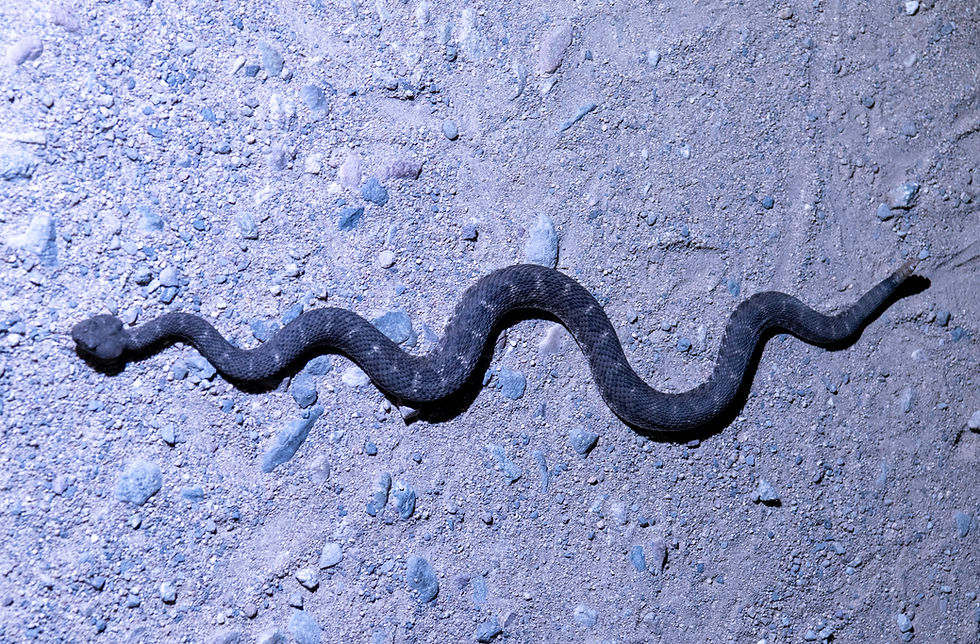
The Saddled Leaf-nosed Snake is a small, subtly colored serpent that reaches a maximum length of around 20 inches (approximately 510 mm). Its smooth, shiny scales range from pale cream to tan or light gray, providing effective camouflage against desert soils. A distinctive pattern of fewer than 18 dark, saddle-shaped blotches—typically brown or gray-brown—runs along the body. These blotches are separated by lighter skin tones, sometimes pinkish or creamy. Its head is only slightly broader than the neck, and the snout is blunt, bearing a prominent, shield-like rostral scale that is thick, triangular, and specialized for digging. The pupils are vertically elliptical, and the underside is plain and unmarked, usually white or pale gray. A narrow, dark line stretches from the top of the head through the eye to the upper lip.
The Milksnake boasts one of the broadest ranges of any North American snake, extending from southeastern Canada through much of the United States and into Central America as far south as Ecuador. In the western United States, populations are known from northeastern and southeastern Arizona, including areas such as the Little Colorado River drainage and regions near Holbrook, St. Johns, and Petrified Forest National Park. It has also been recorded in parts of Utah and Montana. The species is typically found from near sea level up to elevations of about 9,000 feet (2,740 meters), although in Arizona it is most often encountered between 4,200 and 6,200 feet.
The Saddled Leaf-nosed Snake is native to the southwestern United States and northwestern Mexico. It is primarily found in south-central Arizona, including the areas from Tucson to the Organ Pipe Cactus National Monument, as well as parts of the Phoenix-Superior region. The species also ranges southward into central and southern Sinaloa, Mexico. Its elevation range is generally between 1,000 and 3,000 feet (300–910 meters). This species occupies arid desert habitats and is typically associated with the Sonoran Desertscrub community, especially within the Arizona Upland subdivision. It can also be found in the Lower Colorado River Valley subdivision and extends into thornscrub and the lower margins of thornforest in the southern part of its range. Preferred terrain includes rocky bajadas, gravelly slopes, and coarse, sandy soils. The snake tends to dwell higher on desert hillsides than its close relative, the Spotted Leaf-nosed Snake, though it occasionally appears in desert flatlands. Primarily nocturnal, the Saddled Leaf-nosed Snake is most frequently observed on warm, humid summer nights, especially following the onset of seasonal rains. It often remains hidden beneath the surface during the day, using its specialized snout to burrow into loose soil. Seasonal hibernation begins in late fall and continues through winter. Observations are most commonly made during night drives on remote desert roads. This species exhibits a highly specialized diet, feeding almost exclusively on reptile eggs—primarily those of lizards, and possibly other snakes. Its digging behavior, facilitated by the large rostral scale, is thought to aid in locating and unearthing nests. Although rare, it may occasionally consume small lizards. Breeding likely occurs in spring or early summer, with females laying clutches of 2 to 6 eggs during the warmer months. Hatchlings typically emerge by mid to late summer, with reports of young snakes appearing as early as July. Despite its cryptic nature and limited visibility in the wild, Phyllorhynchus browni is distinguishable from its close cousin, the Spotted Leaf-nosed Snake (Phyllorhynchus decurtatus), by its fewer dorsal blotches and different color tones.
References:
Stebbins, R. C., & McGinnis, S. M. (2018). Peterson Field Guide to Western Reptiles and Amphibians (4th ed.). Houghton Mifflin Harcourt.
Brennan, T. C. (n.d.-e). Saddled Leaf-nosed Snake. The Reptiles and Amphibians of Arizona. https://reptilesofaz.org/snakes-subpages/h-p-browni/
Brennan, T. C., & Holycross, A. T. (2006). A field guide to Amphibians and reptiles in Arizona (2nd ed.). Arizona Game and Fish Dept.